
Allen bolts are widely used fasteners in mechanical equipment, construction parts, electrical products, and industrial assemblies. They are compact, clean, and easy to install in narrow spaces. But one problem often troubles buyers: the hex socket gets stripped. Today, I will explain why it happens and how to avoid it during procurement and assembly.
A stripped Allen bolt may look like a small problem. But in real production, it can stop the line, damage the part, and waste labor time. If the bolt cannot be removed, the cost becomes even higher. I’m Monica Song from Hengrui, and I have seen many buyers lose time because of this small but painful issue.
What Does “Stripped Allen Bolt” Mean?
A stripped Allen bolt means the inner hex socket is damaged. The Allen key or hex bit can no longer grip the socket well. When you turn the tool, it slips inside the head.
This usually happens during tightening or removal. Sometimes the socket becomes round. Sometimes the edges inside the hex hole break. Once this happens, normal tools may not work anymore.
In simple words, the tool loses control. The bolt stays there. The worker gets frustrated. Production gets slower.
Cause 1: Wrong Tool Size
The most common reason is using the wrong Allen key size. A tool that is too small may still enter the socket, but it will not contact the six sides correctly. When force is applied, the tool slips and damages the socket.
This problem is common when metric and inch tools are mixed. For example, a metric Allen bolt may be forced with an inch hex key. It may feel “almost right,” but almost right is often wrong in fasteners.
For B2B buyers, I suggest marking tool sizes clearly in assembly areas. Use metric tools for metric bolts. Use inch tools for inch bolts. This simple step can prevent many damaged heads.
Cause 2: Low-Quality Tool
A poor tool can also strip a good bolt. If the Allen key is soft, worn, rounded, or poorly made, it cannot transfer torque correctly. The corners of the tool may deform before the bolt reaches the correct clamping force.
In our sample checks, we often compare three tools: a normal L-key, a T-handle key, and a torque wrench with a good hex bit. The L-key works for light jobs. The T-handle is faster. But for repeated industrial assembly, a torque wrench with a quality bit is much safer.
A good fastener still needs a good tool. I always tell buyers: do not save one dollar on a tool and then damage hundreds of bolts.
Cause 3: Over-Torque
Over-torque is another major reason. Every bolt has a torque limit. If the worker keeps tightening beyond that limit, the socket can deform. The thread may also stretch or fail.
Torque is affected by size, material, grade, thread pitch, lubrication, and surface finish. A zinc-plated bolt may not behave exactly like a black oxide bolt. A stainless steel bolt may also need more care because of galling risk.
For important assemblies, do not rely only on hand feeling. Use a Allen bolt torque specs chart as a starting point. Then confirm the final value with your engineer.
Cause 4: Shallow Hex Socket
Some Allen bolts have a shallow hex socket. This gives less contact area between the tool and the bolt. Under higher torque, the tool may slip more easily.
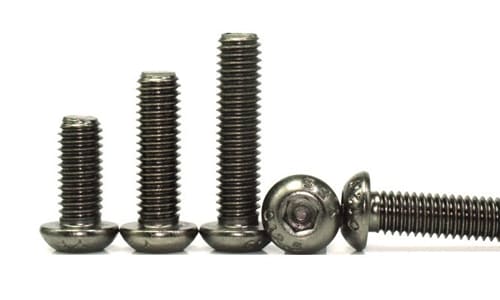
This problem is more common with low head socket bolts, button head socket bolts, or small-size screws. Their heads are lower, so the socket depth may also be limited.
This does not mean these bolts are bad. It means they must be used in the right place. If high torque is required, a standard socket head cap screw may be a better choice than a low head or button head screw.
Cause 5: Wrong Bolt Type for the Application
Different Allen bolts are made for different jobs. A socket head cap bolt is usually stronger and better for high-load machinery. A button head socket bolt is better for appearance and light to medium-duty use. A flat head socket bolt is used when the head must sit flush.
If a buyer chooses a button head bolt only because it looks better, but the assembly needs high strength, problems may appear later. The socket may strip. The head may deform. The joint may loosen.
This is why selection matters. The bolt type must match the load, space, surface, and installation method.
Cause 6: Poor Material or Heat Treatment
Material quality is very important. A bolt made from poor steel may not have enough hardness or strength. If heat treatment is not controlled well, the head may be too soft or too brittle.
For high-strength Allen bolts, buyers often choose alloy steel grades such as 10.9 or 12.9. For corrosion resistance, buyers may choose stainless steel 304 or 316. But material choice should always match the application.
If the project has high load, vibration, or repeated assembly, ask your supplier for material information, grade, and test reports when needed.
Cause 7: Surface Finish and Friction Issues
Surface finish affects more than appearance. It affects corrosion resistance and friction. Friction affects torque. This is why the same size bolt may behave differently with black oxide, zinc plating, nickel plating, or Geomet coating.
If the finish is too thick or uneven, it may affect the socket or thread. If the coating is not suitable for the environment, rust may appear. Rust makes removal harder and increases the risk of stripping during maintenance.
For outdoor equipment, oil and gas projects, tower and pole parts, or wind energy use, surface finish must be selected carefully.
Cause 8: Rust, Dirt, or Thread Locking
A bolt may also strip during removal. This is common when the bolt has rust, dirt, thread locker, or long service life. The bolt may be stuck, so the worker uses more force. Then the socket fails.
Before removing old Allen bolts, clean the socket first. Make sure the tool seats fully inside the hole. If the bolt is rusted, use the right loosening method before applying high force.
In maintenance work, patience saves money. Forcing a damaged or dirty socket is usually the fastest way to make the problem worse.
How to Prevent Allen Bolts from Stripping?
First, choose the right bolt type. Do not use low head or button head screws when a standard socket head cap bolt is needed for strength. Do not use stainless steel only because it looks better. Match the bolt to the real working condition.
Second, use the correct tool. The tool must match the bolt size. It should be clean, sharp, and not worn. For repeated production, use controlled torque tools.
Third, control torque. Do not guess. Use a torque chart, then confirm it based on your material, finish, lubrication, and assembly design.
Contact Hengrui for Custom Socket Head Cap Bolts
A stripped Allen bolt is not always a worker’s fault. It may be a tool problem, a design problem, a material problem, or a supplier problem. Good procurement reduces these risks before production starts.
If you need standard or custom Allen bolts, you can contact me at info@hrfastener.com. Send us your drawing, size, material, finish, grade, and quantity. We will help you choose a practical solution for your project.